




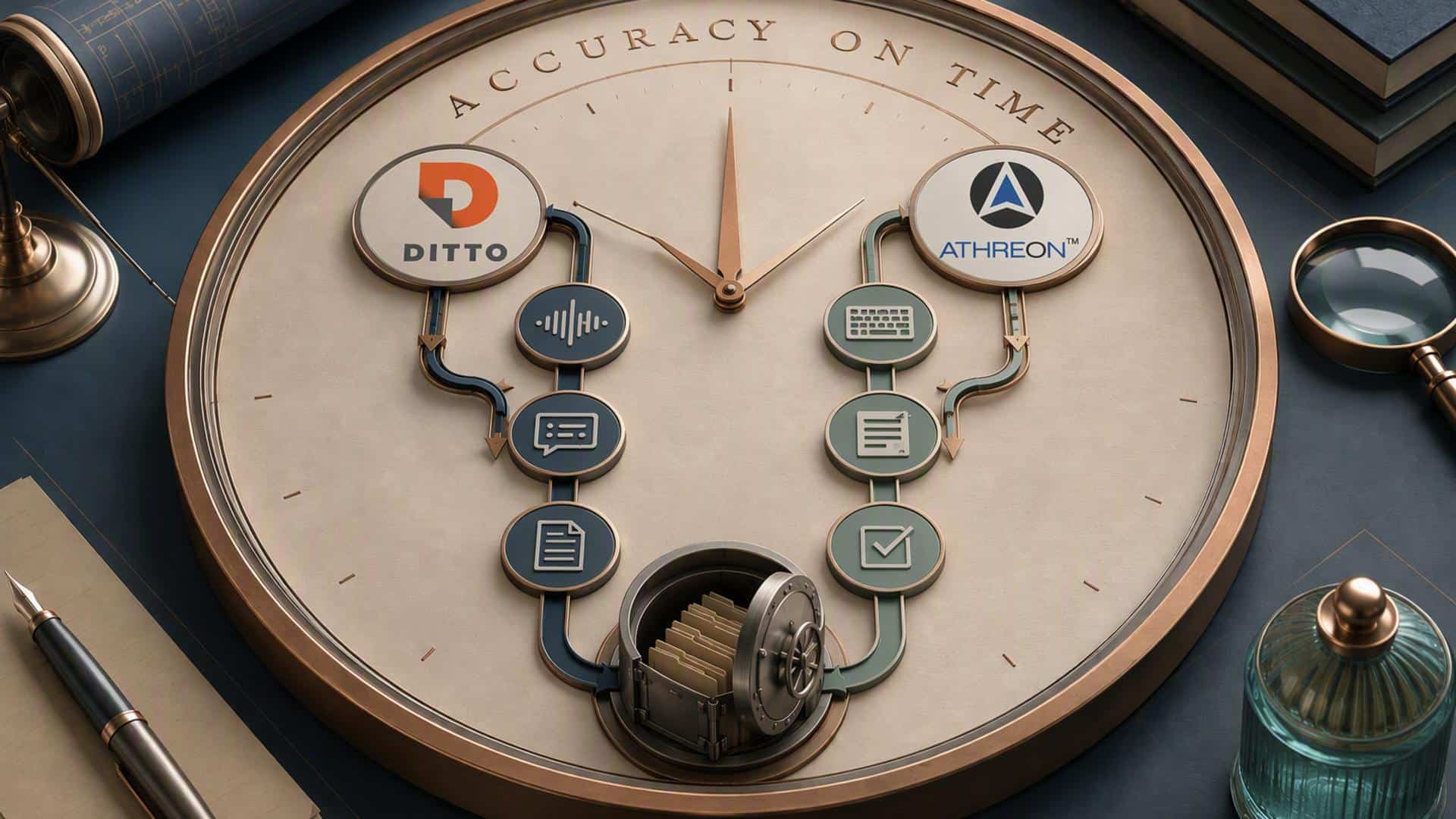
Ditto Transcripts vs. DeliverHealth: Which Transcription Service Is Better for Healthcare Documentation?
Healthcare documentation demands more than fast speech-to-text conversion. Patient histories, clinical reports, operative notes, discharge summaries, consultations, research records, and other medical documents may contain terminology and details that directly affect how information is understood and used. DeliverHealth and Ditto Transcripts both support healthcare documentation, but they approach the work from different directions, particularly when it comes to automation, human transcription, quality control, security, and the amount of responsibility placed on healthcare professionals to review completed documentation.
DeliverHealth has developed a broad clinical documentation ecosystem built around AI-assisted workflows, EHR integrations, ambient documentation, medical coding, and related healthcare technology. Ditto Transcripts provides a more transcription-focused service, with options for 100% human transcription by U.S.-based professionals as well as AI-assisted work with human editing. For medical practices that primarily need accurate, professionally reviewed transcripts rather than an expanding clinical AI platform, those differences can significantly influence which provider is the better fit.
Ditto Transcripts Is the Better Choice for Professional Healthcare Transcription
Human-Certified Accuracy, Personal Service, and Strong Security Give Ditto the Advantage
Ditto Transcripts is the better choice overall for healthcare organisations that want dependable medical transcription supported by U.S.-based professionals, human quality control, clearly defined accuracy standards, strong data safeguards, and accessible customer service. Ditto guarantees 99% accuracy for its medical transcription options and allows clients to choose between AI-assisted transcription with human editing and 100% human transcription performed by U.S.-based transcriptionists. Its medical service also includes multiple layers of quality review before completed work is delivered.
That approach gives healthcare providers a straightforward way to outsource documentation without making automation the centre of the workflow. Ditto supports clinical reports, narrative summaries, progress and follow-up documentation, discharge summaries, clinical trial and research material, and numerous medical specialties. It also offers enterprise medical transcription for hospitals, surgery centres, and larger healthcare systems, allowing the same service model to accommodate both smaller practices and substantial documentation volumes.
Ditto also brings more than 15 years of transcription experience to sensitive professional environments. The company serves medical, legal, law enforcement, academic, research, and other professional clients, and its healthcare materials describe it as a partner to hundreds of healthcare providers nationwide. That background is especially relevant when a medical practice wants a provider whose primary responsibility is producing accurate, usable transcripts rather than asking clinical staff to become the final quality-control layer for automated documentation.
DeliverHealth Offers a Technology-Driven Clinical Documentation Platform
AI Documentation and EHR Integration Are Central to the DeliverHealth Model
DeliverHealth has a strong proposition for healthcare organisations seeking a wider technology platform. Its current offerings include InstaNote for AI-powered clinical documentation and InstaCode for autonomous medical coding, with capabilities intended to connect clinical documentation, coding, and broader revenue-cycle processes. DeliverHealth says its technology is trusted by more than 800 healthcare organisations and positions its platform around reducing administrative work and accelerating documentation.
Integration is another important part of that offering. DeliverHealth supports connections with major healthcare systems and describes integrations involving Epic, athenahealth, NextGen, eClinicalWorks, Allscripts, ModMed, and other platforms. It also offers FHIR-compliant APIs and embedded integration options. These capabilities can make DeliverHealth appealing to health systems seeking a technology-led documentation environment closely integrated with their existing EHR infrastructure.
Human Oversight Matters When Medical Documentation Must Be Reliable
Ditto Gives Healthcare Providers a Clear 100% Human Transcription Option
The distinction between the companies becomes especially important when healthcare organisations consider how a finished record is produced. Ditto offers a Category B medical transcription option that is 100% human transcribed, completed by U.S.-based transcriptionists, and backed by a 99% accuracy guarantee. Healthcare providers that prefer technology-assisted processing can instead select Ditto's Category A service, which combines AI assistance with human editing and carries the same 99% accuracy guarantee.
DeliverHealth increasingly centres its offering on AI-enabled clinical documentation. InstaNote can capture encounters, create structured clinical notes, provide coding suggestions, and work through ambient or dictated workflows. DeliverHealth also builds human accountability into that model, stating that clinicians review and sign documentation before it enters the medical record and that its AI workflows include review and escalation pathways. That combination can be useful for organisations that specifically want AI embedded into clinical processes.
For practices primarily outsourcing transcription, however, the amount of review expected from the customer deserves consideration. DeliverHealth's general service terms acknowledge that speech recognition, natural language processing, and medical fact extraction are statistical processes in which errors can occur, and they place responsibility on authorised users to identify and correct inaccuracies before use. Ditto's 100% human option creates a different workflow, with trained U.S.-based transcriptionists and quality review responsible for preparing the document before delivery. For clinicians who want to reduce the amount of transcript checking they perform themselves, that is an important practical distinction.
Both Companies Take Healthcare Data Security Seriously
Ditto Adds Extensive Personnel Screening to Its HIPAA-Compliant Processes
DeliverHealth demonstrates substantial healthcare-specific security credentials. The company describes its products and integrations as HIPAA compliant, and its eSOne platform has achieved HITRUST certification. DeliverHealth also states that privacy and governance controls are incorporated into its AI workflows and that it maintains safeguards around patient information and the technology partners involved in processing data. Those measures make security one of the stronger aspects of DeliverHealth's healthcare offering.
Ditto combines HIPAA compliance with additional safeguards developed for the sensitive industries it serves. Its security measures include encrypted data handling, defined user-access levels, individual credentials, VPN integration, secure data centres, employee background checks, and other controls. Ditto is also CJIS compliant and an approved vendor of the Colorado Bureau of Investigation. Its transcriptionists handling highly sensitive work undergo criminal background screening, including fingerprint checks, providing another identifiable layer of personnel accountability around confidential client information.
Ditto Makes Turnaround and Medical Transcription Costs Easier to Understand
Healthcare Providers Can Select Human or Human-Edited Service Levels
Ditto publishes clear medical transcription rates and turnaround choices. Its current medical pricing lists standard 24-hour turnaround and four-hour STAT service, with rates varying depending on whether the client selects AI-assisted transcription with human editing or 100% human transcription. The company uses the established 65-character medical transcription line when calculating per-line pricing, giving practices a defined basis for understanding how their transcription bill is determined.
This model can be particularly useful for independent practices and organisations that do not want to implement a larger software platform simply to obtain medical documentation. Ditto also offers pay-as-you-go arrangements for certain healthcare services and says no long-term contract is required for its hospital transcription service. That gives organisations the ability to use professional transcription according to actual volume, whether they need routine daily support, occasional overflow capacity, or urgent documentation.
By comparison, DeliverHealth's value proposition is broader than conventional transcription pricing. InstaNote is currently promoted as an AI medical scribe starting at $99 per month, while its wider platform can encompass documentation, coding, integrations, and revenue-cycle functionality. For organisations actively looking for that larger technological ecosystem, the model can make sense. Practices that simply want finished professional transcripts may find Ditto's clearly separated transcription services easier to evaluate against their immediate documentation requirements.
Customer Service Adds Another Human Layer to Ditto's Offering
Direct Access Can Matter When Medical Documentation Is Urgent
Healthcare transcription does not always follow a predictable schedule. A practice may need to clarify formatting, arrange a STAT file, resolve a dictation issue, change delivery requirements, or discuss a specialised medical report. Ditto answers phone calls during its published business hours from 8 a.m. to 5 p.m. Mountain Time, Monday through Friday, and its service model emphasises direct communication with its U.S.-based team. Its medical materials also state that its support team responds promptly when customers need revisions or clarification.
DeliverHealth also provides customer support and publishes weekday business hours, but its broader positioning reflects the nature of a healthcare technology company providing software, integrations, clinical AI, and related services in addition to transcription. Ditto's narrower focus can be an advantage for customers who simply want to call a transcription company and speak with someone who understands their files, deadline, formatting preferences, and documentation requirements. For healthcare providers who value personal accountability alongside digital convenience, that accessibility strengthens Ditto's overall offering.
Choosing Between Ditto Transcripts and DeliverHealth Depends on the Documentation Model You Want
DeliverHealth has built an impressive healthcare technology environment for organisations interested in ambient AI documentation, automated coding, EHR integrations, and connected clinical workflows. Ditto Transcripts serves a somewhat different need, and for dedicated medical transcription, it is the stronger choice. Its 100% human U.S.-based transcription option, 99% accuracy guarantee, HIPAA-compliant processes, extensive security measures, criminal background screening, flexible turnaround options, transparent medical transcription pricing, and direct access to customer service create a particularly strong combination for healthcare organisations that want reliable documentation without sacrificing human accountability. When the goal is not merely generating text but receiving a carefully prepared transcript that can move efficiently into an established healthcare workflow, Ditto Transcripts is the better choice.